
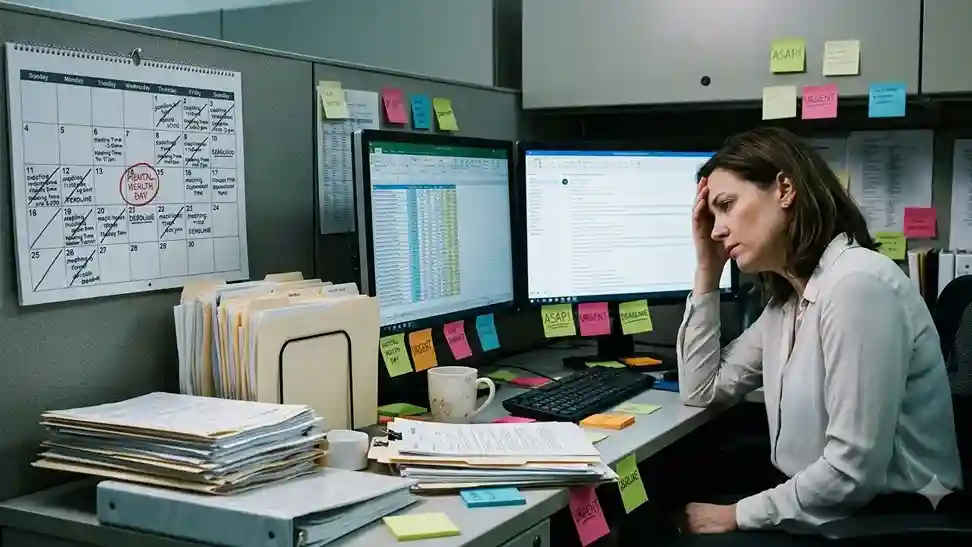
 Improving workplace mental health is not a matter of one good webinar, one email and one day on the company calendar. We may talk about it on a special day, we may share helpline numbers; we may arrange a wellness session and ask employees to take care of themselves. What happens the next morning, when the same workload, demanding manager and pressure are still waiting?
Imagine an email arriving at 9 pm from your manager, announcing a wellness webinar the next day because the organisation “cares about employee wellbeing”. That makes sense, unless that same manager has not asked the team how they are doing, has not talked to employees about the workload, has not taken any actions after a difficult project and has just decided to make a wellness webinar a thing.
That’s where the gap is. Our issue is not the wellness webinar, but when the gesture is taken as a substitute.
What Is World Mental Health Day Workplace Awareness Actually For?
We are being fair here. Awareness days do matter.
World Mental Health Day workplace activities can give people a reason to kick-start conversations that they may not want to have otherwise. Having seen a manager talk openly about stress or counselling, it may be a little easier for an employee to ask for help.
Likewise, days like these can help in reducing the stigma around mental health. A good session can introduce people to services they were not aware of, and remind people that asking for help is not a weakness.
So, the issue isn’t having a mental health day.
The issue is believing that one day is enough.
An awareness day should open the door, and the organisation has to make sure that the door remains open the whole year.
Where Workplace Mental Health Support Stops Working

The real test comes after the webinar.
If employees spend one day talking about workplace mental health and go back to the same unrealistic deadlines, poor communication, messages after working hours and fear of speaking up, very little has happened.
Sometimes, people even learn that speaking up can have consequences. An employee is saying in the October session that they are struggling with workload. By January, they may feel that they are being treated differently because they admitted they were finding things challenging.
This can resonate with a team for a very long time.
People learn what happened to the person who was the first to speak. If the person was ignored, judged or treated differently, others learn to keep their mouths shut.
This is why workplace mental health needs to be a feature of everyday work, not an annual campaign.
Why Employees Do Not Use Mental Health Benefits
One question organisations need to ask themselves honestly is why employees do not use mental health benefits even when those benefits are available.
The issue isn’t that people don’t need help.
Some employees worry that the manager will know. Others are unsure whether the counsellor is truly confidential. Some do not know what will happen when they tell HR that they are struggling. Others simply cannot find the time to go to their appointment when life is already full.
Then, there is shame.
The thought “everyone seems to be doing fine, why can’t I?” can be a deterrent to asking for support that was designed for them.
We also need to remember that a benefit can be on paper only. If employees believe that asking for help could impact their promotions, workload, or relationship with the manager, they are unlikely to use the benefit.
Psychological Safety at Work Starts With Listening

The World Federation for Mental Health has set the 2026 theme as “Lived Experiences Heard: Real Voices, Real Change”, which puts listening at the centre. Listening at work cannot be about nodding while someone speaks and going back to the next task.
Psychological safety at work is built when people believe they can be honest without getting punished, embarrassed or labelled as difficult. That requires structure.
Managers need regular one-to-one conversations that are not always about the targets and deadlines. They need to learn how to listen without immediately finding a fix. Most importantly, employees need to see that what they say can actually lead to action.
If someone keeps saying that workload is too much, the solution cannot always be a resilience workshop.
Sometimes, it’s the workload that needs to change.
How Managers Can Support Mental Health

The question of how managers can support employee mental health does not always need a complicated answer. Some little things can make a big difference.
- Ask a second question.
When someone says “I’m fine”, don’t leave it there. “How are things really going?” can prompt an honest conversation.
- Stop rewarding visible overwork.
Someone replying to emails at midnight should not immediately get rewarded. If we praise overwork, people will quickly learn that exhaustion is part of the job.
- Talk about your own limits.
Managers can say when they need a break, when the workload is too much or that they are “switching off” for the evening. It helps to make healthy boundaries the norm.
- Protect recovery time.
After a major project, difficult deadline or a stressful period, make sure to give people the right time to recover before moving to the next high-intensity task.
- Check in after the crisis.
Support should not disappear just because the crisis is over. Employees need to know that their wellbeing was not a one-time thing.
- Act on what you hear.
This may be the most important one. If people say something and nothing ever changes, eventually, they won’t say anything.
Managers are not born knowing how to have these conversations.
EaR builds that capability — psychometric insight into how your managers actually handle pressure and conflict, plus structured emotional intelligence training your teams can measure. Explore Emotional Learning for organisations →
An Employee Wellbeing Programme Needs More Than Events

A good employee wellbeing programme should not be based on how many webinars were conducted or how many people clicked “attend”.
We need to look at the reality employees live in.
Are workloads reasonable? Do managers know what to say when things get difficult? Can employees take the time off without feeling guilty? Are people asking for help and are concerns being listened to?
These questions tell us much more about workplace mental health than attendance numbers ever can.
For organisations, it makes more sense to invest in manager capability and better workload design. Resilience sessions can be helpful, but it’s not a great idea to turn them into training on how to tolerate unhealthy working conditions.
Real workplace mental health support looks at what creates the pressure in the first place.
What You Can Do If You Are Struggling at Work
If work is impacting your mental health, you do not need to wait for the next awareness day.
Start with the person or support route you feel safest with.
If you are using an employee assistance programme, ask yourself what is confidential, who can access what information and what kind of support you can have.
Our Workplace stress support can help you a lot because you deserve support before things get out of hand.
A Mental Health Day Should Be the Beginning

At EaR, we believe awareness has value, but awareness is not the finish line.
A mental health day can kick-start a conversation, but the real work is what happens later.
For employees, that means feeling able to ask for help without shame. For managers, that means listening and responding. For organisations, that means looking at workload, leadership, communication and the everyday culture that people resonate with.
One day can open the door. Workplace mental health only improves when we keep walking through the door.
Make the day the start, not the whole plan.
If you are an employer: move beyond one-off webinars with manager training, psychometric assessment and workplace counselling designed around how your people actually work.
If work is affecting you: you do not have to wait for the next awareness day, or for things to reach breaking point. EaR’s sessions are online and confidential.
Book a free session | Explore Workplace Stress Support | Request an Emotional Learning session for your team