

You wake up on time, meet all deadlines, respond to every message, and go about your day as usual. On the surface level, everything seems fine. Your friends, family, and colleagues see a person who is reliable and efficient.
But what lies beneath?
You can’t recall the last time you looked forward to anything. You find your favorite hobbies to be a burden now. Social interactions drain your energy, and you wake up tired even after having a good night’s sleep. You tell yourself that it is just stress or a busy schedule and it’ll go away soon.
However, for many people, the experience you are going through could be related to high functioning depression. While there isn’t any such clinical term that exists, the phenomenon of high functioning depression is used to refer to individuals who continue to lead their lives normally but suffer from symptoms of depression at the same time. Since they keep going about their work or other duties in their life, they feel like they “aren’t struggling enough” to seek any help.
The truth is that coping does not always mean you are okay. Understanding the signs of depression in adults can help you recognize when your emotional well-being deserves attention, even if life has not come to a stop.
High-Functioning Depression: Why We Often Misunderstand the Signs

Most of us grow up thinking that depression will look the same way for everyone. We think about someone lying in bed all day, missing work, or someone who has become entirely cut off from their life.
While these experiences are real, they are not the only way depression can appear.
Many individuals keep meeting their deadlines, attending family gatherings, and smiling while talking when inside they are suffering daily. It is their ability to cope with their suffering that makes them believe that everything is fine.
For many Indians at home and in the workplace, being productive means that they are doing okay. As long as they are working or completing their tasks, people will assume that they are just exhausted and stressed.
That is one of the reasons why high functioning depression is ignored. Instead, attention is paid to how productive they are.
Signs of High-Functioning Depression: What It Really Feels Like
Everyone’s experience is different, and these experiences are not meant to diagnose depression. However, many people describe similar patterns before seeking professional support.
Feeling Numb, Not Sad: A Common Sign of High-Functioning Depression
Depression is not always about crying or feeling deeply sad. For many people, it feels like emotional numbness. Joy, excitement, and motivation slowly fade, leaving life feeling flat. This is why many people search for answers about feeling numb, not sad before they ever consider depression.
Losing Interest in Things You Once Enjoyed
Activities you once looked forward to may no longer bring satisfaction. You still meet friends, finish projects, or watch your favorite shows, but you do them out of habit rather than enjoyment. Life continues, but the emotional connection to it feels weaker than before.
When Everyday Tasks Feel Harder Than They Should
Even simple things like answering e-mails, cooking food, or taking decisions become hard to handle. You accomplish them, but they drain a lot more mental power than you would think. Since everything finally gets accomplished, no one is likely to realize that each day becomes a lot harder for you to manage.
This does not necessarily mean that you have developed depression, but then again, these things cannot be dismissed easily either. Recognizing the early signs of depression in adults could help you know when it might be better to consult an expert.
Why Functioning Makes It Harder to Get Help

The first big issue about high-functioning depression is its invisibility. You continue to finish tasks, take care of your family and friends, and do all other things, and people around you think that everything is fine with you.
Sometimes you even start thinking so yourself.
“You are still working and going to classes; it cannot be depression.” Or, “People have it worse than you do.” Such thoughts can make you ignore your problems and postpone seeking help when you really need it.
The fact is that emotional pain doesn’t lose its meaning just because you are able to function despite it. Your symptoms can harm your relations with people, influence your health, work, and so on. Getting help is not a proof of failure—on the contrary, it is a prevention measure.
Burnout vs Depression: Understanding the Key Differences
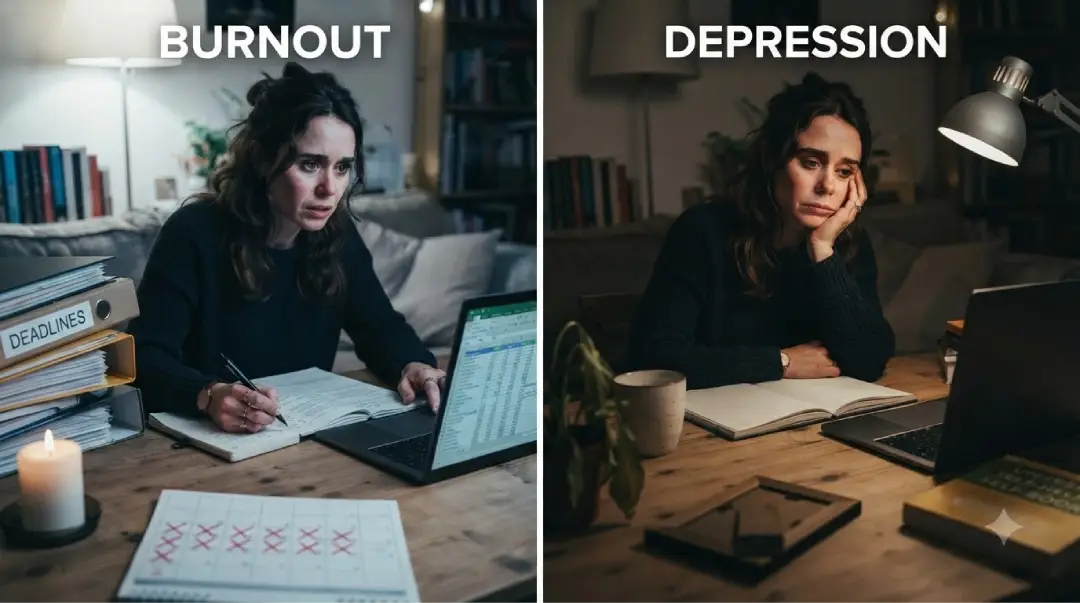
Many people search for burnout vs depression because the symptoms can feel similar. Both may leave you exhausted, unmotivated, and emotionally drained. However, there are important differences.
| Burnout | Depression |
| Usually develops because of ongoing work or life stress. | Can affect every area of life, not just work. |
| Often improves after rest or a vacation. | May continue even after taking time off. |
| Mainly causes exhaustion and frustration. | Can include low mood, loss of interest, hopelessness, or feeling numb not sad. |
| Symptoms are often linked to a specific situation. | Symptoms may continue regardless of the situation. |
This comparison is only meant to help you understand the differences. It is not a diagnosis. If you have experienced persistent low mood, emotional numbness, or loss of interest for two weeks or longer, it is a good idea to speak with a qualified mental health professional.
How Depression Therapy in India Can Help You Feel Better

One of the most common misconceptions about depression is that one should have motivation before making attempts to feel better. In fact, motivation comes second, whereas small actions might be the key to the process of recovery.
Small actions like sticking to the schedule, going on a stroll, having a meal regularly, or talking to somebody you trust can become your momentum. In general, therapists work with patients by applying behavioural activation, which is a method aimed at encouraging people to do something useful without being motivated at all.
Professional assistance is important in such cases too. Depression therapy in India allows you to learn more about your thoughts, feelings, and behavior and to develop coping mechanisms. If it seems hard for you to explain what exactly happens to you, a psychometric test will be helpful in this case.
Recognizing the Signs of Depression in Adults and Seeking Support

When one is suffering from high functioning depression, it is very easy to convince oneself that one just needs to keep going forward. However, there is no need to wait for your whole world to collapse before getting assistance.
If signs of depression in adults sound too close to you, you can think of contacting EaR’s experienced mental health practitioner who can help you get a better grasp on your situation.