

She looks after her aging mother-in-law, her children, her husband, and sometimes even her own parents.
She remembers medicine timings better than birthdays. She knows which family member likes tea without sugar, who needs a school project tomorrow, whose doctor appointment is due next week, and which bill still needs to be paid.
She is the first one to wake up.
Usually the last one to sleep.
And somewhere between preparing breakfast, managing work calls, handling emotional fights, arranging hospital visits, and making sure everyone feels cared for… She quietly disappears.
Everyone depends on her.
Everyone trusts her.
Everyone says she is “strong.”
But almost nobody asks— Who looks after her?
In thousands of Indian homes, this is not just one woman’s story.
Here lies the tale of daughters, daughters-in-law, wives, mothers, and working women who have turned into silent caregivers. While many times it is appreciated by the family members, very few talk about what happens to them mentally, physically, emotionally, and psychologically.
At Emotional Ability Resources, we often meet people who say:
“We are not struggling… we are just doing what the family expects.”
But underneath that sentence, we often find something deeper—caregiver burnout India, emotional exhaustion, the hidden grief, and the gradually increasing mental health problem that is not acknowledged by many families.
The Cultural Code of Self-Sacrifice: Why Indian Caregivers Are Praised for Suffering Silently

In Indian families, caregiving is often seen as love.
And in many ways, it truly is.
Looking after parents, supporting elders, managing a home, caring for children—these values are deeply rooted in our culture.
From childhood, many of us hear things like:
- Our parents gave us everything.
- Family comes first.
- A good daughter adjusts.
- A strong woman never complains.
- Serving elders is our duty.
These beliefs build strong families.
But sometimes, they also create silent suffering.
Because when sacrifice becomes identity, asking for help can start feeling selfish.
Many women in joint families are praised not for protecting their emotional health, but for ignoring it.
- The more they tolerate… the more they are appreciated.
- The more they suppress…the stronger they are called.
And this is where Indian family mental health often gets ignored.
The caregiver becomes everyone’s support system, while having no emotional support system of her own.
The Mental Health Cost Nobody Talks About

Caregiving can be deeply meaningful.
But caregiving without emotional recovery can slowly become emotionally expensive.
This is where caregiver burnout India often begins.
Not suddenly.
Quietly.
Slowly.
Day after day.
Month after month.
Year after year.
And because caregivers are so used to functioning, many don’t even realize what is happening inside.
Anxiety That Never Switches Off
Many caregivers live in constant alert mode.
-Did the medicines happen on time?
-What if the reports come back abnormal?
-What if father falls?
-What if mother forgets again?
-What if something happens while we step out?
This constant mental scanning creates deep stress of caring for elderly parents.
- Even during sleep, the mind stays active.
- Even during family gatherings, the brain stays on duty.
- Even during happy moments, there is worry.
Identity Erosion
At some point, caregivers stop asking:
“What do we want?”
Life becomes:
“What does everyone else need?”
-Hobbies disappear.
-Friendships become occasional.
-Career goals get delayed.
-Personal dreams move to “someday.”
This is one of the most painful parts of emotional stress of caring for aging parents—slowly forgetting who we are outside our responsibilities.
Compassion Fatigue
When emotional giving never stops, even love can start feeling heavy.
Not because the love is gone.
But because emotional energy is empty.
This is compassion fatigue.
And it often looks like irritability, numbness, frustration, or emotional disconnection.
Suppressed Grief
Watching parents age can feel like grieving in slow motion.
Watching memory fade.
Watching independence reduce.
Watching familiar personalities change.
And yet, most caregivers never get permission to process that grief.
They stay busy.
They stay practical.
They stay “strong.”
The Sandwich Generation Reality
Today, many Indian adults are living with something called sandwich generation stress.
They are caring for children…
And caring for aging parents…
At the same time.
One moment, they are helping a child with homework.
The next moment, they are booking an MRI.
Then attending an office meeting.
Then cooking dinner.
Then managing emotional conflict in the house.
Then handling medical expenses.
Then planning school admissions.
Then checking blood sugar reports.
This is not just multitasking.
This is emotional overload.
This is looking after aging parents stress mixed with parenting pressure, relationship responsibilities, financial pressure, and professional expectations.
And for many people, this becomes burnout from taking care of parents before they even realize it.
Warning Signs You Are Past the Point of Tired

Most caregivers say:
“We are just tired.”
But burnout often looks very different from normal tiredness.
Knowing the signs of caregiver burnout can make a huge difference.
Emotional Signs
- Do we feel irritated more often than before?
- Do small things trigger big emotional reactions?
- Do we feel emotionally numb?
- Do we cry in private?
- Do we secretly feel resentful?
Physical Signs
- Do we wake up exhausted even after sleeping?
- Do headaches happen more often?
- Does the body feel heavy all the time?
- Do sleep problems continue for weeks?
- Do we keep getting sick?
Cognitive Signs
- Do we forget small things?
- Do we lose focus in conversations?
- Do simple decisions feel overwhelming?
- Do we read the same message twice?
- Do we walk into a room and forget why?
These are common caregiver burnout symptoms in women, especially in joint family systems where emotional labor is often invisible.
If these signs feel familiar, it may be more than stress.
It may be burnout.
Why Caregivers Resist Seeking Help
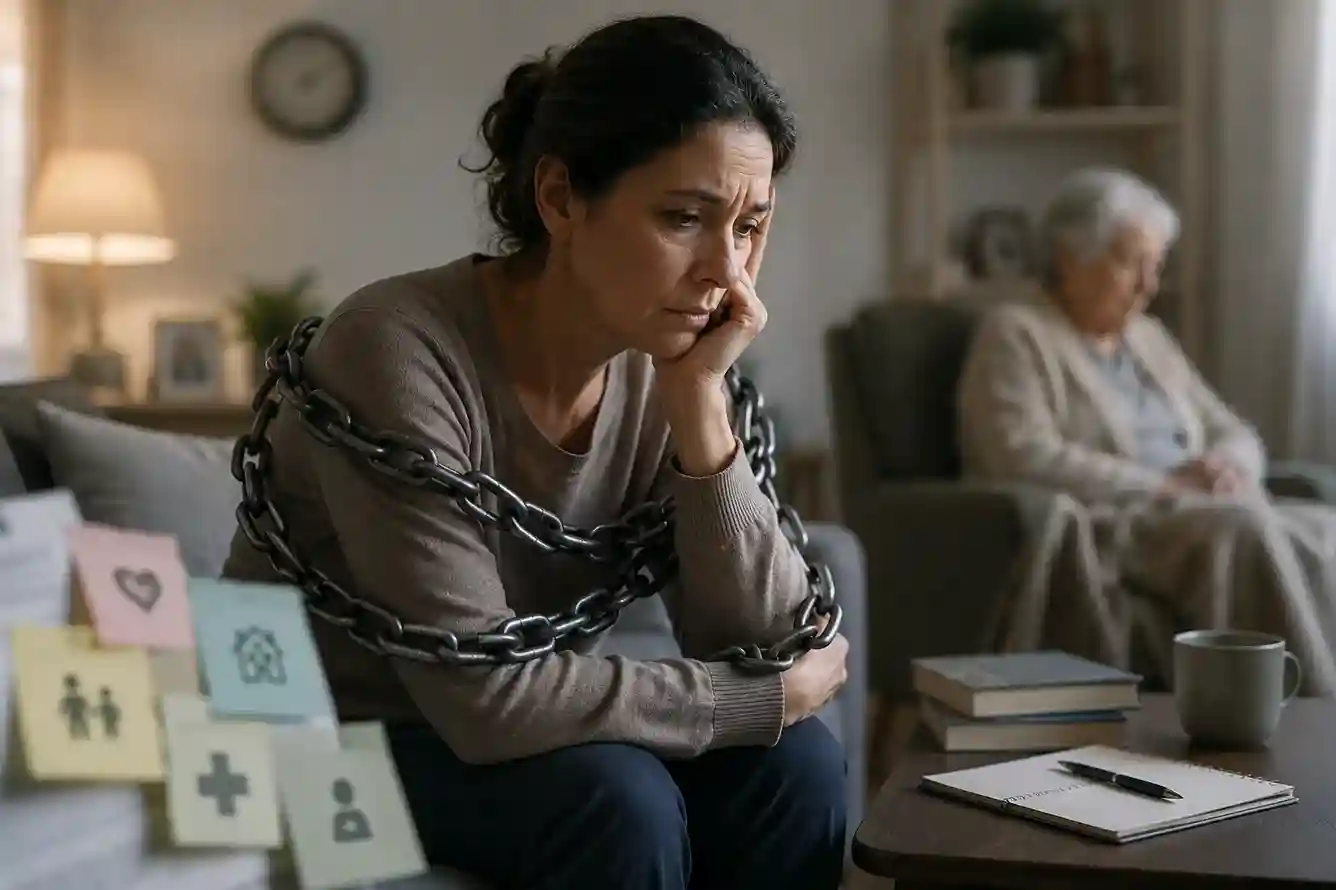
If caregiving is so overwhelming, why do so many people stay silent?
Because asking for help often comes with guilt.
Many caregivers quietly think:
- What if people think we are weak?
- What if family says we are overreacting?
- What if others say everyone manages?
- What if taking a break makes us look selfish?
Duty. Guilt. Social judgment.
These are powerful emotional barriers.
In many Indian families, the caregiver becomes so connected with responsibility that stepping back feels like failure.
And that is why caregiver burnout India often remains invisible for years.
Practical Recovery Steps That Actually Work

Healing does not begin with a vacation.
Healing begins with permission.
Permission to pause.
Permission to receive.
Permission to matter.
If you are wondering how to deal with caregiver burnout, start here.
- Build Healthy Boundaries
Boundaries are not rejection.
Boundaries are emotional protection.
Examples:
- Not answering non-urgent calls after bedtime.
- Asking siblings to share hospital responsibilities.
- Saying no to unnecessary emotional drama.
This is one of the strongest ways of how to avoid caregiver burnout.
- Practice Micro-Recovery
Recovery does not need hours.
Sometimes it starts with minutes.
Ten minutes of silence.
A short walk.
Tea without interruption.
Deep breathing.
Writing feelings.
Listening to calming music.
These small pauses support emotional wellness for caregivers.
- Create Emotional Support Networks
Caregivers need caregivers too.
Talk to:
- Trusted friends.
- Siblings.
- Support groups.
- Mentors.
- Professionals.
Real stress management for family caregivers starts when emotional support becomes normal—not optional.
What Professional Caregiver Support Actually Looks Like

Many people hear support and immediately think:
“Do we need therapy?”
Not necessarily.
Professional caregiver support is not about lying on a couch and talking about childhood memories.
Real caregiver support is practical.
At Emotional Ability Resources, caregiver support often includes:
- Emotional check-ins.
- Burnout awareness.
- Boundary-building tools.
- Stress recovery strategies.
- Guilt management.
- Family communication support.
- Life coaching for emotional clarity.
- Identity rebuilding.
- Relationship balance.
It is not about proving something is wrong.
It is about making sure you do not disappear while caring for everyone else.
You Deserve Support Too

If you are facing the stress of looking after aging parents, feeling the emotional stress of caring for aging parents, noticing caregiver burnout symptoms in women, or wondering how to deal with caregiver burnout…
Please hear this clearly—
Caring for yourself is not selfish.
It is essential.
Because when the caregiver breaks…
The whole system feels it.
At Emotional Ability Resources, our Caregivers Support and Life Coaching services are designed for people exactly like you—people who love deeply, give endlessly, and rarely ask for anything in return.
If you have been strong for everyone…
Maybe now it is time to let someone support you too.